




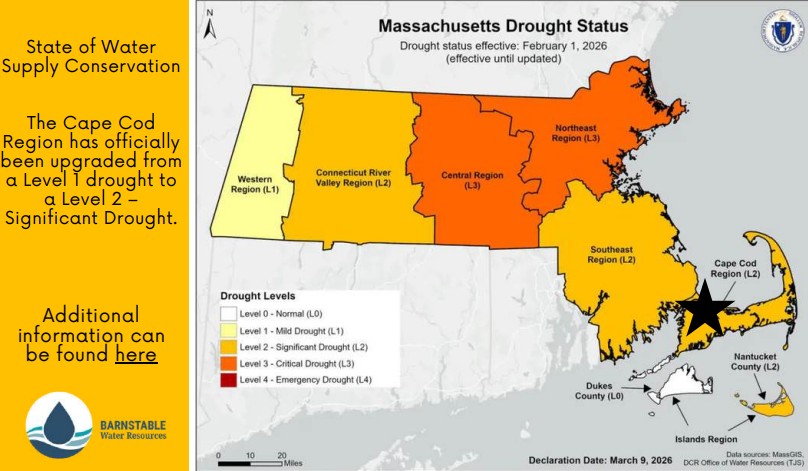
 BARNSTABLE — Cape Cod remains under a Level 2 — Significant Drought designation as state officials continue to monitor worsening dry conditions across Massachusetts and urge residents to conserve water heading into the summer season.
A drought map released by the Massachusetts Executive Office of Energy and Environmental Affairs (EEA) shows the Cape Cod Region, along with the Southeast and Islands regions, in a significant drought. Other parts of the state are experiencing even more severe conditions, with northeastern Massachusetts classified under a Level 3 — Critical Drought designation.
According to the EEA and the Massachusetts Drought Management Task Force, the Level 2 declaration follows two years of below-average rainfall and declining streamflow and groundwater levels across the state. During May, Massachusetts received between 1 and 3 inches of rain, approximately 1.5 to 3 inches below normal levels.
Federal data compiled by the National Integrated Drought Information System also shows Barnstable County has experienced significantly below-normal precipitation this year and is among the driest years on record through the first several months of 2026.
State officials warn that prolonged dry conditions are placing increasing stress on water supplies, rivers, ponds, wetlands and vegetation. Dry conditions can also elevate the risk of brush fires and wildfires, particularly during the summer months when water demand rises and vegetation becomes increasingly parched.
The current drought conditions represent a setback from earlier this spring, when Cape Cod had briefly improved to a Level 1 — Mild Drought status. However, continued below-normal rainfall and ongoing groundwater deficits prompted state officials to return the region to a Level 2 designation.
Under a significant drought declaration, the state strongly encourages residents and businesses to minimize outdoor water use, limit lawn irrigation, repair leaks and adopt water conservation measures whenever possible. Individual communities may also impose local watering restrictions based on the needs of their municipal water systems.
“The current drought, which began in 2024, continues to affect the natural environment and water resources across Massachusetts,” state officials said in recent drought updates.
The Massachusetts Drought Management Task Force will continue to monitor precipitation, groundwater and streamflow conditions and issue updated drought declarations as conditions change.
Sources: Massachusetts Executive Office of Energy and Environmental Affairs, Massachusetts Drought Management Task Force and the National Integrated Drought Information System.