




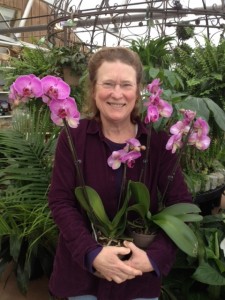
C.L. Fornari is known as “The Garden Lady.”
By NANCY RUBIN STUART
Has winter got you down? Snow-blinded—or blindsided? Tired of seeing everything white? Not if you’re the plant and garden expert C. L. Fornari, who always manages to be surrounded by flowers and greenery. A self-described “garden geek,” she is the author of books on plants and gardens and a popular lecturer.
As a college student at the University of Wisconsin, Fornari never expected to devote her life to horticulture. Instead, she studied art. After graduation she became an artist who specialized in photo-generated collages.
“Sometimes I included plants and flowers but they weren’t the main subject,” she said.
By 1993 when Fornari and her husband arrived on Cape Cod, she felt she needed to expand in a different direction. “I’d always enjoyed gardening but when I moved here I was surprised to find out there were no books on the plants and flowers of Cape Cod.”
That absence led her to visit gardens, take pictures of them and talk to local gardeners. Inspired, she then wrote a book proposal about Cape Cod gardens but met with little success. “The big publishers said it was too local and the smaller ones claimed a full color book was too expensive,” Fornari recalled.
Refusing to give up, she began to study plants seriously and began working at the Country Gardens nursery in Hyannis which led to her horticultural expertise.
Eventually Fornari published six books. One of them, published in 1996 and recently updated in full color was her original idea, “The Cape Cod Garden.” Her most recent book is the widely acclaimed “Coffee for Roses….and 70 Other Myths about Backyard Gardening” published in 2014.
One of the most common myths she attempts to dismiss is about moss. “People think it grows only in the shade but that’s not true. Moss can grow in full sun as well as in dark or damp places—anywhere, in fact, where there is compact soil.”
Another myth she’d like to erase is the practice of placing stones or rocks in the bottom of plant pots. “It’s a silly idea that serves no purpose at all. We don’t know where it started but think about it, professional growers never put stones in the bottom of potted plants.”
Fornari remains fascinated with plants for several reasons; their vast variety, the beauty of flowers and also their economy. “There’s no other life on earth that does what plants do. They are the only life form that creates energy rather than consumes it. They do it silently by absorbing carbon dioxide and using sunlight and water to grow. The rest of the world—animals and humans—gets their energy from plants. Animals eat them to survive. People eat plants as well as animals.”
To Cape Codders who suffer from the winter blues, Fornari suggests buying “temporary” house plants—forced bulbs or flowering plants to add color to their homes. Another antidote is to start planning your warm weather garden by ordering seeds for early spring growth. Attendance at a flower show such as The Boston Flower & Garden Show March 11 to 15 can also remedy the monotony of winter.
Fornari doesn’t have to wait long to enjoy a touch of spring though. At this writing, she was about to leave for Seattle, Washington where she will lecture at the Northwest Flower & Garden Show. There everything is already coming up roses.