





FALMOUTH – The Town of Falmouth is proposing to build an outfall pipe for treated wastewater discharging into Nantucket Sound.
The town says by sewering the densely-developed south coast area and connecting it to the outfall, coastal pond water quality would improve, and the impact of treated water discharged into land will be avoided.
The proposed discharge site is at Kite Park.
The project is still in the permit phase; construction wouldn’t start until 2029.
Wastewater outfall pipes are not new in Massachusetts, but they have been resisted in Cape Cod towns for decades even as nitrogen-impaired bodies of water have become more well-documented and the state updated its Title 5 septic regulations. Falmouth had been considering outfall pipe options going back at least 15 years.
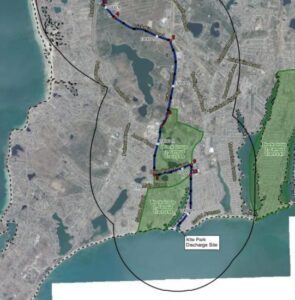
Map of proposed ocean outfall pipe from Town of Falmouth
The Massachusetts Ocean Sanctuaries Act of 1970 establishes five Ocean Sanctuaries in state waters including Cape Cod Bay and the Cape and Islands. The dumping or discharge of commercial, municipal, domestic or industrial wastes, is “prohibited with exceptions”.
Marshfield, which accepts waste from other South Shore towns, uses a “12 port diffuser” about 3,000 feet offshore near the Brant Rock tower. That area is exempted from the Ocean Sanctuaries Act.
In 2021, there was opposition to a proposed outfall pipe servicing Wareham that would have gone in the Cape Cod Canal in Bourne. The Massachusetts Maritime Academy holds a separate EPA permit to discharge wastewater into the Canal.
The Deer Island outfall pipe intended to clean up Boston Harbor began operations in 2000.
In 2005, the Center for Coastal Studies in Provincetown concluded the outfall had minimal impact on Cape Cod Bay and the food supply of the North Atlantic right whale.
The Massachusetts Water Resources Authority has also regularly reviewed the data, and says it continues to show no unexpected or serious effects on Massachusetts and Cape Cod Bays from the Deer Island Treatment Plant discharges.
However, there have been concerns raised about the Deer Island project sending microplastics downstream.
Earlier this year, the Massachusetts Division of Marine Fisheries said shellfisheries statewide are being impacted by increasing closures associated with wastewater discharges from both Combined Sewer Overflows and wastewater treatment plant outfalls. From the DMF:
The National Shellfish Sanitation Program has long-required permanent shellfishing closures around wastewater treatment plant outfalls to protect public health.
In 2015, the NSSP adopted new criteria for determining the size and configuration of these required safety zones. DMF has been working since then to evaluate and reclassify these Prohibited and Conditionally Approved areas while trying to minimize the impacts on shellfishing activities and the aquaculture industry. In so doing, we identified a critical need for hydrodynamic modeling and partnered with Dr. Changsheng Chen from the University of Massachusetts School for Marine Science and Technology for technical assistance in modeling WWTP effluent dilution and dispersion to inform decisions on shellfish growing area sanitary classification around WWTP outfalls.
Advanced modeling and reclassification have already taken place for the Scituate WWTP discharging in the North and South Rivers in Scituate and Marshfield, and the New Bedford and Fairhaven WWTPs that discharge into Buzzards Bay. For Scituate and Marshfield, model results showed that effluent did not significantly travel upriver and achieved considerable dilution downriver once outside the embayment. Data collected on the Scituate WWTP’s fully treated effluent also showed that it is a high performing plant.
In New Bedford and Fairhaven, modeling similarly showed how environmental conditions affect the dispersion of WWTP effluent in Buzzards Bay. While model results showed extensive areas of Buzzards Bay potentially impacted by the WWTP effluent, including longstanding aquaculture operations, DMF committed to expanding our lab capacity and testing efforts to justify classifying those important aquaculture areas as Conditionally Approved rather than Prohibited. Emergency CSO closures occurred in portions of Buzzards Bay 20 times due to CSO activations in New Bedford in 2024, for a total of 210 days lost to harvest for the year.
By Jim McCabe, CapeCod.com NewsCenter
 About Jim McCabe