




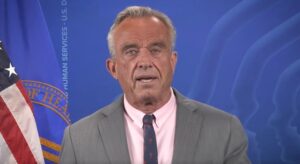
U.S. Department of Health and Human Services Secretary Robert F. Kennedy Jr.
WASHINGTON (AP) — The Department of Health and Human Services plans to cancel contracts and pull funding for some vaccines being developed to fight respiratory viruses like COVID-19 and the flu under the direction of Health Secretary Robert F. Kennedy Jr.
RFK Jr. announced Tuesday that $500 million worth of vaccine development projects using mRNA technology will be halted. The 22 projects are led by major pharmaceutical companies like Pfizer and Moderna.
In a social media video, Kennedy said HHS was “prioritizing the development of safer, broader vaccine strategies, like whole-virus vaccines and novel platforms that don’t collapse when viruses mutate.”
Kennedy’s decision to terminate the projects is the latest in a string of decisions that have put the longtime vaccine critic’s doubts about shots into full effect at the nation’s health department. Kennedy has pulled back recommendations around the COVID-19 shots, fired the panel that makes vaccine recommendations, and refused to offer a vigorous endorsement of vaccinations as a measles outbreak worsened.
Infectious disease experts say the mRNA technology used in vaccines is safe, and they credit its development during the first Trump administration with slowing the 2020 coronavirus pandemic as “Operation Warp Speed”, the federal effort to facilitate the development and distribution of a COVID-19 vaccine, was launched. President Trump, in his first term, hailed mRNA vaccines as a “medical miracle.” Future pandemics, those experts warned, will be harder to stop without the help of mRNA.
“I don’t think I’ve seen a more dangerous decision in public health in my 50 years in the business,” said Mike Osterholm, a University of Minnesota expert on infectious diseases and pandemic preparations.
He noted mRNA technology offers potential advantages of rapid production, crucial in the event of a new pandemic that requires a new vaccine.
The shelving of the mRNA projects is short-sighted as concerns about a bird flu pandemic continue to loom, said Dr. Paul Offit, a vaccine expert at Children’s Hospital of Philadelphia.
“It’s certainly saved millions of lives,” Offit said of the existing mRNA vaccines.
Scientists are using mRNA for more than infectious disease vaccines, with researchers around the world exploring its use for cancer immunotherapies. At the White House earlier this year, billionaire tech entrepreneur Larry Ellison praised mRNA for its potential to treat cancer.
Traditionally, vaccines have required growing pieces of viruses, often in chicken eggs or giant vats of cells, then purifying that material. The mRNA approach starts with a snippet of genetic code that carries instructions for making proteins. Scientists pick the protein to target, inject that blueprint and the body makes just enough to trigger immune protection — producing its own vaccine dose.
The “m” in mRNA stands for messenger because the vaccine carries instructions for our bodies to make proteins.
In a statement Tuesday, HHS said “other uses of mRNA technology within the department are not impacted by this announcement.”
The mRNA technology is used in approved COVID-19 and RSV shots, but has not yet been approved for a flu shot. Moderna, which was studying a combination COVID-19 and flu mRNA shot, had said it believed mRNA could speed up production of flu shots compared with traditional vaccines.
The abandoned mRNA projects signal a “shift in vaccine development priorities,” the health department said in its statement, adding that it will start “investing in better solutions.”
“Let me be absolutely clear, HHS supports safe, effective vaccines for every American who wants them,” Kennedy said in the statement.
Speaking hours later Tuesday at a news conference in Anchorage, Alaska, alongside the state’s two Republican U.S. senators, Kennedy said work is underway on an alternative.
He said a “universal vaccine” that mimics “natural immunity” is the administration’s focus.
“It could be effective — we believe it’s going to be effective — against not only coronaviruses, but also flu,” he said.
The two scientists whose discoveries enabled the creation of mRNA vaccines against COVID-19 won a Nobel Prize in 2023 for their work.
KENNEDY: “As the pandemic showed us, mRNA vaccines don’t perform well against viruses that infect the upper respiratory tract.”
THE FACTS: His claim is contradicted by scientific evidence. Countless studies show that vaccinated individuals fare far better against COVID-19 infections than those who are unvaccinated, while others have estimated that COVID-19 vaccines prevented millions of deaths during the global pandemic. The mRNA vaccines do not prevent respiratory diseases entirely, experts say. Rather, they can prevent more serious illness that leads to complications and death. For example, an mRNA vaccine against COVID-19 may prevent an infection in the upper respiratory tract that feels like a bad cold from spreading to the lower respiratory tract, where it could affect one’s ability to breathe.
Plus, years of research supports the effectiveness of COVID-19 vaccines that use mRNA technology.
COVID-19 is the only virus for which real-world data on mRNA vaccine effectiveness is currently available.
“A vaccine cannot block a respiratory infection,” said Dr. Jake Scott, an infectious diseases physician and clinical associate professor at Stanford University School of Medicine. “That’s never been the standard for a respiratory virus vaccine. And it’s never been the expectation, and it’s never been that realistic.” He called Kennedy’s claim “misguided.”
“Vaccinations don’t have to be neutralizing, meaning that you’re not going to get COVID,” said Jeff Coller, a professor of RNA biology and therapeutics at Johns Hopkins University. “But the important part of a vaccination is that they reduce hospitalization and death. And a reduction in hospitalization and death is proof of an effective vaccine.”
Myriad studies on the effectiveness of COVID-19 vaccines have been published since they first became available in late 2020. Although protection does wane over time, they provide the strongest barrier against severe infection and death.
“What I don’t understand is why is President Trump is allowing RFK Jr. to undermine his legacy that led to a medical intervention that literally saved millions of lives?” Coller said. “Why is Trump allowing RFK to undermine U.S. leadership in biomedical research and drug development?”
Story by The Associated Press
 About Jim McCabe