




Courtesy: Atlantic White Shark Conservancy
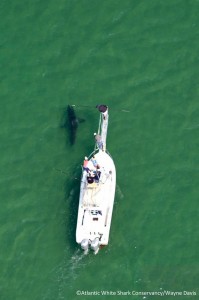
First great white shark of 2015 tagged off Chatham
CHATHAM – With the recent footage of a great white shark jumping out of the water as it chases after a seal off Monomoy, the researchers studying the animals were in the news again this week.
Shark biologists Gregory Skomal and John Chisholm from the Massachusetts Division of Marine Fisheries are in year two of a five-year population study of great white sharks with the help of a relatively new nonprofit the Atlantic White Shark Conservancy, which is funding the work.
Cynthia Wigren, co-founder and president of the Atlantic White Shark Conservancy, said the researchers began seeing more great white sharks earlier in the season this year than last year.
“It’s been a very active and busy start to the season so we’ve been excited about how much activity there’s been compared to last year at this time,” she said.
The great white shark season off Cape Cod lasts from about May through the fall.
“We know from receivers in the water that they are leaving the area around December,” Wigren said.
But last year, the shark sighting season for the researchers did not really pick up until August, Wigren said. By the time the research was completed in October, researchers had recorded 68 sharks.
In contract, this year the researchers started seeing multiple sharks in the water in July and a lot of those sharks have been “new” sharks, meaning they were not identified and catalogued among the 68 that were viewed last year.
Identifying and cataloging the sharks is different from tagging them, Wigren explained. It involves using two GoPro cameras that are strapped to painter poles and placed in the water near the shark.
“You get as much underwater footage as you possibly can of the shark to look for unique markings,” she said.
Part of the population study that the scientists are interested in is how many of the sharks identified last year will be seen again in Cape waters.
The eventual goal, Wigren said, is to get a population estimate of how many white sharks are coming to the Cape.
The conservancy’s funding has been critical in allowing the researchers to see more sharks, she said.
“Now that the scientists have an organization behind them that can fund the work, it allowed for a lot more time on the water,” Wigren said.
The researchers go out two days a week from mid-June through the end of October.
On a typical day out on the water for the researchers, spotter pilot Wayne Davis heads out first and scans the area from the tip of Monomoy to the Nauset Inlet.
Then the researchers head out, going up and down the coast from Monomoy to Orleans, looking for seal activity and recording what they see: how many seals are hauled out along the shore, for example.
When Davis spots a great white shark, he direct the boat to the shark. The crew then works to get underwater footage of both sides of the shark using the Go-Pro cameras, recording the animal’s markings.
“There’s a lot of communication between the spotter pilot and the captain of the boat to really have the shark right next to the boat,” Wigren said.
Once Skomal believes he has enough footage to be able to identify the shark, he brings out the tagging pole to try to tag the shark.
“Some of it is a lot of chasing around on the water trying to get as close to the shark as possible,” she said.
By end of the July, the researchers had spotted at least 11 great white sharks.
But in August, the sightings have increased. The researchers have tagged at least 10 sharks since Friday.
The first shark of the season that was tagged this year happened to be one that was tagged last year. That particular shark had been tagged with a device that was set to deploy within 12 months. This year Skomal fitted the same shark with an acoustic tag that is supposed to last at least five years, Wigren said.
“We know from the receiver coverage that only one tagged shark has come back that was tagged in 2012. The rest are new and haven’t been seen in the population study,” Wigren said.
Click below to hear the entire interview with Cynthia Wigren, co-founder and president of the Atlantic White Shark Conservancy.








Speak Your Mind